By Federico Calabrese
Follow us on social networks to stay updated on the latest transfer market news: Instagram, Facebook e X
Index
Over the past fifteen years, Atlético Madrid has gone from being Spain’s “third force” to a model of sustainability and ambition in European football. Not only on the pitch — where, under Diego Simeone, the club has won trophies and earned widespread respect — but also in its finances, where it has demonstrated remarkable ability to transform itself from a mid-sized club into a global enterprise with revenues exceeding €400 million.

Atlético Madrid’s Economic Structure
Atlético’s financial growth is clearly visible in the numbers. In the 2013–14 season, the club’s revenue was around €170 million; by 2023–24, that figure had surpassed €440 million. In just a decade, the club has nearly tripled its income, securing a stable position among the top fifteen football teams in Europe by revenue. According to the 2024 Deloitte Football Money League report, Atlético Madrid ranks twelfth in the world — a result that confirms the club’s financial maturity and its ability to compete with the global powerhouses of the game.
To understand Atlético’s financial structure, it is necessary to examine its main sources of income: broadcasting rights, match-day revenue, and commercial activities. It is a delicate balance in which each component plays an essential role, influenced by both sporting performance and broader market dynamics.

Revenue Breakdown
The most significant share comes from broadcasting rights, which alone account for more than half of total revenue. In 2023–24, the club earned approximately €218 million from broadcasting — a 19% increase compared to the previous year. This growth was mainly driven by participation in the UEFA Champions League and the centralized distribution of La Liga’s TV rights, which in recent years has aimed for a fairer redistribution among clubs. However, the dependence on European performance remains evident: an early exit from continental competitions can erase tens of millions of euros in a matter of months.
Other Pillars of Income
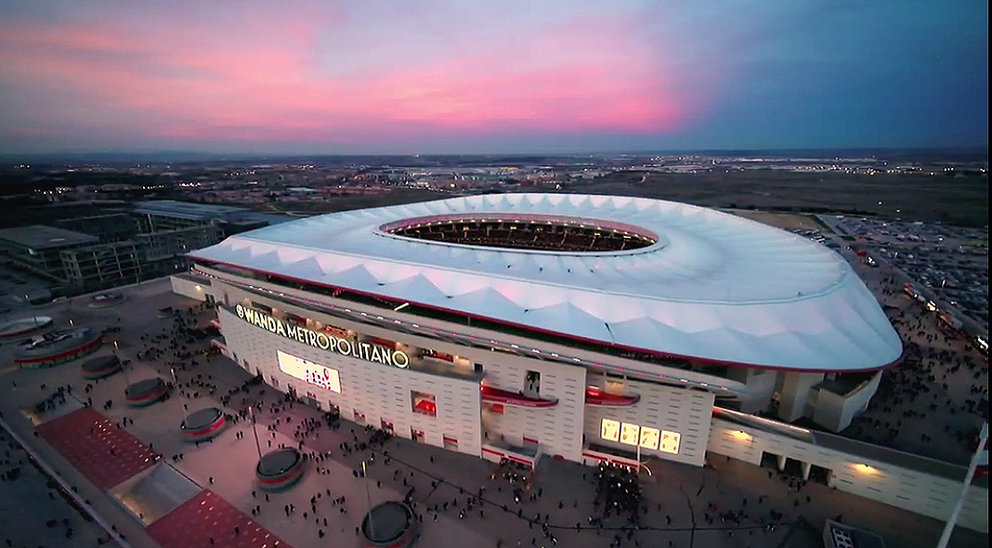
The second major source of revenue, match-day income, has benefited enormously from the move to the Wanda Metropolitano — a state-of-the-art 70,000-seat stadium inaugurated in 2017. This venue has allowed Atlético Madrid to expand its earning potential, not only through ticket sales but also via hospitality, corporate events, and concessions. In 2023–24, stadium revenue reached €74 million, marking a 23% increase year-on-year. This is a strong sign of fan loyalty, but also proof of the club’s ability to turn passion into a high-value economic experience.
The third pillar is commercial revenue — a sector in which the club has been working intensively to strengthen its international identity. Income from sponsorships, merchandising, and licensing stands at around €117 million, slightly lower than the previous year but still significant. One of the most notable examples of this strategy is the shirt sponsorship deal with WhaleFin, a cryptocurrency platform, reportedly worth about $42 million per year. The agreement highlights Atlético’s ambition to expand into new markets and embrace emerging technologies.
Despite revenue growth, cost management remains a central challenge. As in most European clubs, the largest expense is player wages. Before the pandemic, the wage-to-revenue ratio had exceeded 80%, a level considered risky for financial stability. Over the past two years, however, CEO Miguel Ángel Gil Marín and his management team have reduced that ratio to around 69%, the result of a more cautious spending policy and a series of targeted transfer-market decisions.
The transfer market itself plays an important role in Atlético Madrid’s financial equilibrium. Capital gains from the sales of players such as João Félix, Lucas Hernández, and Thomas Partey have helped the club balance its books and reduce its debt. By June 2023, Atlético’s net debt had dropped to approximately €514 million, down from €594 million the year before. Although still a large figure, it is being managed carefully: the club has chosen to invest for the long term, including through the mortgage on its new stadium, following a sustainable model based on predictable cash flow and a solid asset base.
After several years of fluctuations, profitability has shown encouraging signs. In the 2021–22 fiscal year, the club posted a net profit of nearly €40 million, thanks to a combination of strong sporting results and tighter cost control. Nevertheless, margins remain narrow, and profitability still depends heavily on on-field success and player-trading gains.
Stability and Future Prospects
Overall, Atlético Madrid now finds itself in a phase of economic maturity. It is a club that has managed to grow without losing its financial balance — but one that must continue to innovate to remain competitive. The coming years will be crucial for expanding its commercial base, attracting new global sponsors, and gradually reducing the weight of its debt.
The club can rely on several strengths: an internationally growing brand, a modern stadium capable of generating steady income, and a management culture that has become increasingly disciplined and less dependent on short-term improvisation. Still, there are clear risks. The reliance on Champions League qualification remains perhaps the most significant: a disappointing season in Europe can quickly turn into a liquidity issue. Added to this are broader macroeconomic uncertainties that affect sponsorship values and merchandise sales — sectors highly sensitive to consumer confidence and spending power.
Atlético Madrid appears to have found the right path to establish itself as a model of financial balance in European football. It cannot yet compete economically with Real Madrid, Barcelona, or the wealthiest English clubs, but it has carved out its own financial identity built on solidity, controlled growth, and careful resource management. In an era when many clubs spend more than they earn, Atlético’s prudence and consistency could well be its true competitive advantage.
Ultimately, Atlético Madrid is not just a football team — it is a complex economic machine that has learned to operate between the passion of its fans and the rationality of its balance sheet. Its future will depend on maintaining that harmony: continuing to win on the pitch while keeping the accounts balanced off it.