By Andrea Caropreso
Index
Follow us on social media to stay updated on the latest transfer market news: Instagram, Facebook e X.
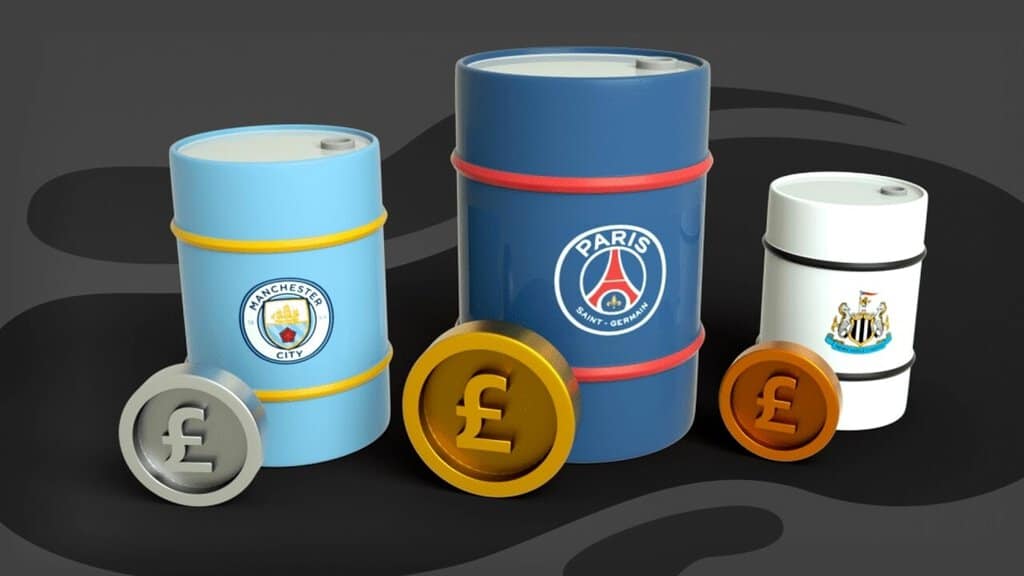
The transformation football has undergone in recent decades is arguably unprecedented. Manchester City, Paris Saint-Germain, and Newcastle represent three emblematic examples of this metamorphosis. This is not a tactical revolution like the one led by Rinus Michels or Arrigo Sacchi, but rather a paradigm shift linked to ownership structures. Specifically, it is the advent of Arab ownerships, each different in philosophy, history, and modus operandi, but with a common goal: rewriting football history by using the sport as a form of soft power to advance their interests.
Manchester City: From Abu Dhabi to the Champions League
When, in 2008, Sheikh Mansour bin Zayed Al Nahyan acquired Manchester City, the club was a mid-table Premier League side, far from the glory of their historic rivals Manchester United. From that moment on, the evolution of the club (and the decline of their city rivals) was radical.
In over fifteen years, City has invested around €3 billion in transfers, with revenues of €1.5 billion, resulting in a net negative balance of more than €1.5 billion. Figures that caught UEFA’s attention and were the basis of multiple charges brought forward by the Football Association (which City still needs to respond to). Numbers that, at first glance, may appear unsustainable, but have been partially offset by a solid management model backed by the financial security of the Emirati state.
One of the most innovative aspects was the creation of the City Football Group, a holding company that today controls around a dozen clubs worldwide, from New York to Melbourne, from Girona to Mumbai. A British-based holding designed to manage a global network of clubs and football-related services, it has become a 360-degree football empire.

From a business perspective, the difference compared to their “cousins” (to put it mildly) at Paris Saint-Germain lies in the model itself. The creation of a holding company has allowed Manchester City (and its affiliated clubs) to benefit commercially and strategically from what is known as a multi-club model, now valued at $4.8 billion. Conversely, Al-Khelaifi’s strategy at PSG has always focused on building up a single club, relying on flashy signings capable of capturing global attention.
Paris Saint-Germain: Qatar’s Show Business
Fresh from winning the Champions League after years of waiting, PSG represents a unique approach among Arab ownerships in football. Three years after Sheikh Mansour’s arrival at City, in 2011, it was Al-Khelaifi’s turn in Paris. The acquisition was carried out through Qatar Sports Investments, a fund directly controlled by Emir Tamim bin Hamad Al Thani.
The growth of the club has mirrored the growth of its massive spending. Economically, the numbers are staggering. Since 2011, the club has spent nearly €2 billion on transfers, with a net balance close to minus €1 billion. Signings often motivated more by image than by sporting necessity. A modus operandi partly reversed two years ago with the arrival of Luis Enrique, which ultimately delivered the long-awaited Champions League title.
At the same time, PSG’s revenues have risen to €806 million in the 2023/24 season, with an overall valuation of $4.4 billion. Sponsorship deals with Qatar Airways, Qatar Tourism, and other Qatari entities have guaranteed constant cash flows, helping the club navigate UEFA’s Financial Fair Play restrictions. The results: domestic dominance in Ligue 1 that has crushed competitiveness, and exponential international growth that culminated in the Champions League triumph just three months ago.
The PIF Takeover: The Newcastle Case
Different still was the entry of Saudi Arabia’s PIF (Public Investment Fund) into European football. This state fund, with far greater resources than the previous two examples, nonetheless did not opt for reckless spending. Since acquiring Newcastle United in 2021, the club has avoided extravagant purchases, despite the deep pockets of its new owners.

Newcastle’s model (and thus PIF’s) can be described as one of patience. Unlike City and PSG, the Saudis chose a gradual approach: targeted signings, young players with potential, and long-term planning aimed at raising the club’s value without wasting money. Isak, Sandro Tonali, and Anthony Gordon are just a few examples. With this method, the historic English club returned to the Champions League and even lifted a trophy again—the League Cup last season, their first in 70 years.
Economically, revenues grew by 28% last season, reaching £320 million, while losses dropped to just £11 million, down from £72 million the previous year. This was also thanks to PIF’s equity injections of around £400 million, without burdening the club with structural debt. Three different models, but a shared goal: using football as an instrument of influence, or, in international relations terms, a form of soft power.
By Andrea Caropreso