By Marta Elena Casanova
Follow us on social networks to stay updated on the latest transfer market news: Instagram, Facebook e X.
Index
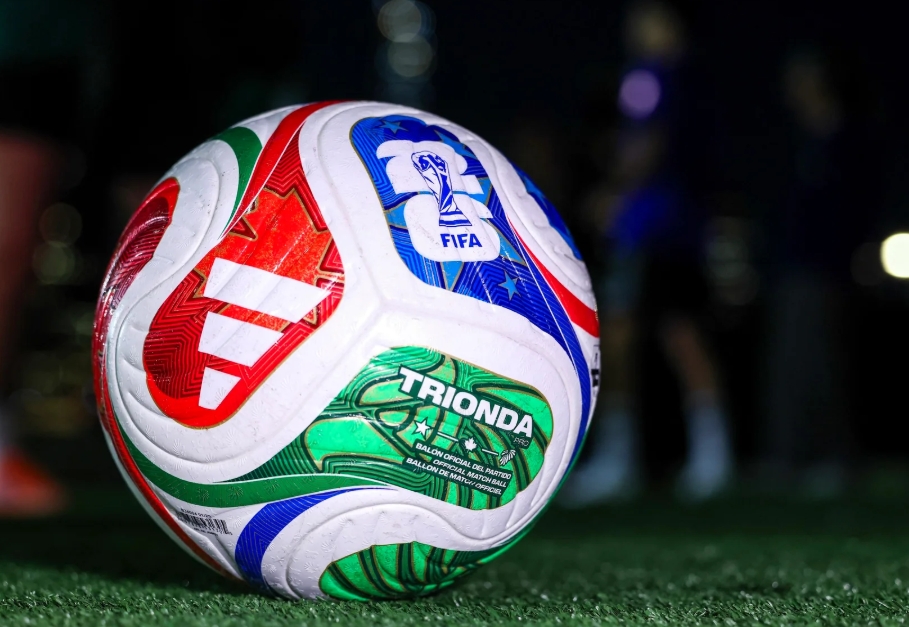
From Telstar to Trionda, when FIFA unveils a new ball, it’s never just about looks. Behind its design, colors, and name lie years of research, commercial strategy, and cultural symbolism. The latest one, Trionda, will star at the 2026 World Cup in Mexico, the United States, and Canada. Its launch marks a new chapter in the long story of official tournament balls — ever more sophisticated, technological, and central to football’s global business.
Trionda, the 2026 World Cup ball
Made once again by Adidas, FIFA’s historic partner since 1970, Trionda has been presented as a masterpiece of innovation. Its four thermally bonded panels — a record for structural simplicity — ensure greater flight stability and passing precision. The surface features ridges and microtextures for improved control, while inside lies a 500 Hz sensor that communicates in real time with VAR to detect touches, goals, or handballs.
The colors — red, green, and blue — recall the flags of the three host nations, while golden streaks evoke the World Cup trophy, a symbol of an event uniting sport, economy, and entertainment.
From Telstar to Jabulani: half a century of evolution
Each ball tells the story of its era. The journey begins with the 1970 Telstar, the first Adidas World Cup ball, famous for its 32 black and white panels designed to stand out on black-and-white TV. From then on, innovation became a ritual.
In the 1990s came the Etrusco Unico, symbol of Italy’s World Cup with its Etruscan-inspired motifs. In 2004, Roteiro introduced thermal bonding instead of stitching, while the Teamgeist (2006) revolutionized design with just 14 curved panels.
The 2010 South Africa World Cup brought the most controversial model — the Jabulani, with eight panels and a smooth aerodynamic surface. Beautiful to look at, but criticized by goalkeepers for its unpredictable flight. After that, Adidas corrected course with Brazuca (2014) and Al Rihla (2022) — more stable and sustainable, thanks to recycled materials and water-based inks.
Each new model is a blend of design, aerodynamics, and storytelling, where performance meets the spirit of the tournament.
The UEFA design school
The UEFA has also built its own design tradition with memorable balls. From Tango 12 at Euro 2012 to Fussballliebe at Euro 2024, every edition carries a message. The latest includes an internal chip linked to referee tracking systems and uses sustainable materials.
Unlike the World Cup, where symbolism is global, UEFA tournaments emphasize the host nations’ visual identity — a way to connect football to the idea of a shared European community through a simple spherical object.
Sponsorship and business: the ball as a global brand
Today, the official ball is not just a technical tool but a planetary marketing product. Adidas holds the monopoly on World Cup and Euro balls, but its role goes beyond supply. Each ball is part of a vast ecosystem of licensing, merchandising, and replica versions.
Fans can buy three versions: Pro (identical to the match ball, around €170), Competition (semi-professional, about €65), and Training, the cheaper one. Each new release generates millions in sales and global visibility, boosted by ad campaigns featuring world stars.
In modern football, the ball is a moving logo — present in every replay, photo, and viral clip. It’s the connection between sponsors, fans, and football history.
Technology serving VAR
The revolution of connected balls is football’s newest frontier. Since Qatar 2022, balls have contained microchips that send instant data to video assistant systems, helping determine offside calls and handballs with precision.
Every ball undergoes tests for bounce, shape, water absorption, and pressure loss under FIFA Quality Pro standards. Materials are also evolving: water-based adhesives, thinner yet stronger polyurethane layers, and eco-friendly production processes.
Once a romantic symbol of street football, the ball has become a small masterpiece of sports engineering.
Between beauty and debate: when the ball divides
Despite innovations, every new model sparks mixed reactions. Purists miss the simplicity of the old Telstar, yet debate is part of football’s magic. Generations change, but the ball remains the thread connecting every emotion in the game.
From the dusty fields of 1970 to the smart sensors of 2026, the official ball has become the mirror of modern football — a perfect fusion of technology, identity, and business.
By Marta Elena Casanova