By Marta Elena Casanova
Follow us on social networks to stay updated on the latest transfer market news: Instagram, Facebook e X.
Index
When people think of German football, the first names that come to mind are always the same: Bayern Munich, Borussia Dortmund, and in recent years, RB Leipzig. But those who follow the Bundesliga closely know there is a club that, despite having fewer financial resources, has managed to carve out a place among the protagonists of German and European football: Union Berlin.
Its recent history shows that with a clear project, a strong bond with supporters, and careful management, it is possible to compete even against clubs with vastly superior capital.
Union Berlin: from difficult beginnings to rebirth
Union Berlin was officially founded in 1966, but its roots go back to the early 20th century, when the first football clubs emerged in the Köpenick district, in the eastern part of the capital. During divided Germany, Union was something of an anomaly: a popular team from East Berlin that stood out for its independence from the regime and for the support of a rebellious, proud, and deeply local fan base. The GDR years did not bring major trophies, but they forged the identity that still defines the club today.
After the fall of the Wall, Union entered a long period of difficulties. Between the 1990s and early 2000s, the club oscillated between the third and second divisions, often held back by financial and structural problems. There were turbulent seasons, denied licenses, and even the risk of disappearing from professional football. But it was precisely in those years that the fans demonstrated how special Union’s story was: they were the ones who contributed, for example, voluntary work to renovate the Stadion An der Alten Försterei, a stadium that to this day symbolizes resistance and community.

A members’ club
Union Berlin does not belong to a foreign magnate or a multinational corporation: it is a Verein, a registered sports association, according to Germany’s 50+1 rule. This means that the main decisions are made by the members, who in recent years have grown exponentially, from just a few thousand to over 60,000. Every fan can take part in the life of the club and vote at general meetings, fostering a model of sporting democracy that in other leagues seems almost utopian.
From an economic perspective, Union has only recently made a remarkable leap forward. In the 2022/23 season, the club posted record revenues of over €170 million, with a net profit of around €18 million: results that allowed it to consolidate its finances and look to the future with more confidence. Yet the philosophy remains one of prudence: no reckless spending, no unaffordable wages, but instead attention to market opportunities, loans, and undervalued players from wealthier clubs.
The climb in the Bundesliga
The turning point came in 2019, when Union won promotion to the Bundesliga for the first time. It was a historic date: the German capital once again had two clubs in the top flight, but while Hertha represented the wealthy West, Union brought with it the popular and stubborn face of the East. On debut, the team surprised everyone by comfortably staying up, finishing 11th.
From there, it was an upward trajectory. In the 2020/21 season, Union finished 7th, securing its first-ever European qualification, to the Conference League. In 2021/22, they went even further, finishing 5th and qualifying for the Europa League, proving they were no longer just a fleeting surprise. But the peak came in 2022/23, when under coach Urs Fischer, the team finished 4th in the Bundesliga: Champions League football, an achievement unimaginable just a few years earlier. Playing against Real Madrid, Napoli, and Braga in the group stage was the crowning moment of the Union fairytale.
The challenges of the present
Of course, dreams also come at a cost. For Union Berlin, the 2023/24 season, with the Champions League commitment, was complicated: the club struggled to cope with the double schedule and finished the league close to the relegation zone, though managing to stay up. The 2024/25 campaign, so far, has also proved transitional, with Union sitting mid-table and aiming to consolidate again.
These ups and downs are the flipside for a club that cannot rely on a deep, expensive squad. European competitions bring revenue, but also extra costs and the need to strengthen the squad. For a club determined to remain faithful to its principles, finding balance is not easy. Nevertheless, the European experience has boosted international visibility and made Union Berlin a recognizable brand even beyond Germany.
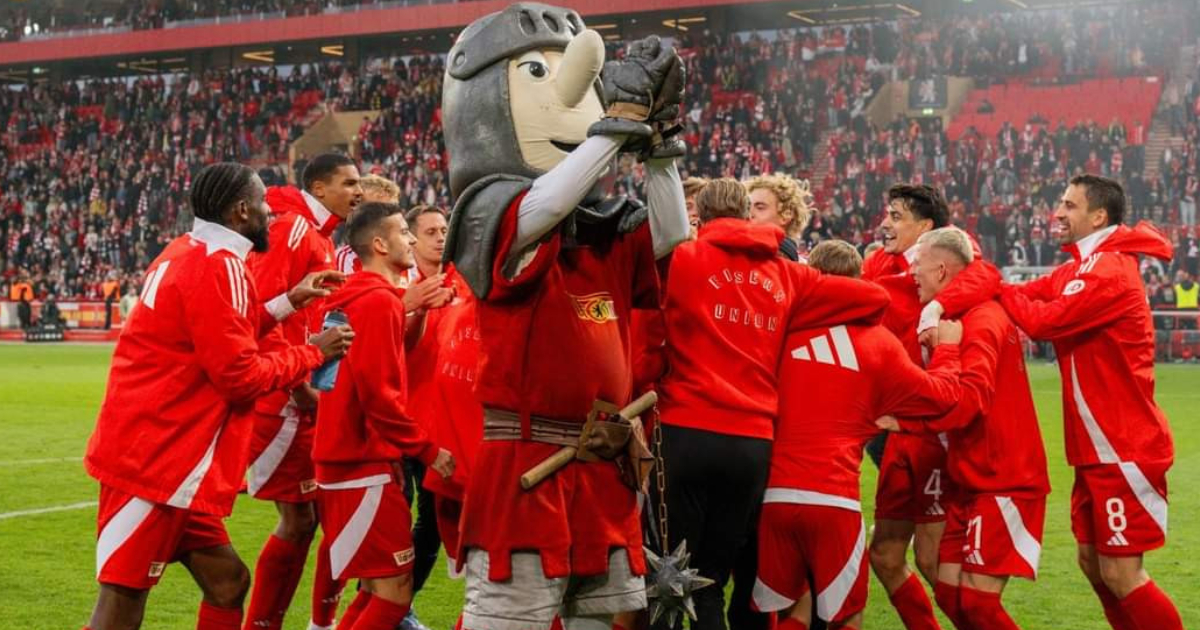
Union Berlin is no longer the “small East team” content just to survive. It has become an alternative model in modern football: a club without billions, but with a strong identity, a loyal community, and careful management. In just a few years, it rose from the second division to the Champions League without betraying its roots.
The future will tell whether Union can establish itself among the Bundesliga’s elite or remain a club hovering between European dreams and relegation battles. But already today, Union’s story sends a powerful message: in globalized, capital-driven football, there are still clubs that grow on their own strength and with the support of their fans. And their success, perhaps, is worth double.
By Marta Elena Casanova